Quarters Down, Culture Up: What Tokyo's Game Centers Know That American Barcades Don't
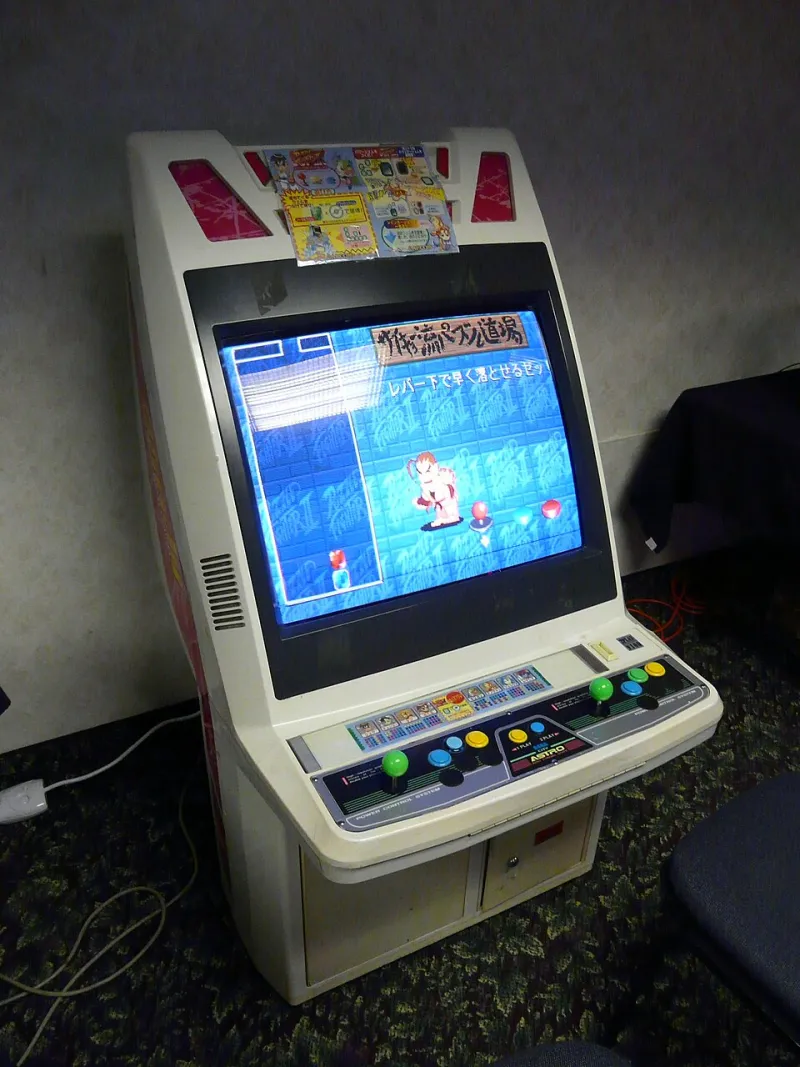
Photo: User:Piotrus, CC BY 3.0, via Wikimedia Commons
Walk into any Giorgio's or Round1 here in the States and you'll get the idea: the American arcade is a nostalgia product. Neon signs, a Foo Fighters cover band in the corner, a cabinet of Time Crisis missing its gun. It's a theme restaurant with a token economy.
Now walk into a Taito Station in Shinjuku at 9 PM on a Tuesday. It's loud. It's packed. It's mostly people under 25, and nobody is there for the nachos.
That gap — between arcade-as-memory and arcade-as-habit — is the whole story.
The Coin-Op Never Died, It Just Moved
When arcades collapsed in America in the mid-'90s, the usual suspects get blamed: home consoles, Mortal Kombat controversy, the mall dying. All true, partially. But the deeper reason was that the US arcade was never a business on its own terms. It was an add-on to something else — a pizza parlor, a movie theater, a mall anchor store. When the host died, the parasite died with it.
In Japan, the game center was always its own institution. Multi-floor buildings in dense urban areas, run by operators like Taito, Adonis, and GiGO, with revenue models that evolved instead of collapsed. Crane games got cheaper to stock and more obsessive to collect. Rhythm games like CHUNITHM and maimai turned music licensing into a recurring revenue engine. Card-based games — think Aime and Amusement IC — created membership ecosystems that Western arcades never attempted.
Seoul and Taipei followed similar logic. PC bang culture in Korea pulled some of the same social-gaming function, but arcade rhythm and fighting scenes persisted in pockets like Sinchon and Ximending, sustained by competitive communities rather than tourism.
Cabinets First, Ports Later
Here's the thing most American players don't realize: studios are still building games for cabinets first. Sega's AM2 descendants, Konami's rhythm teams, and a whole ecosystem of Japanese arcade developers treat the cabinet as the premium release. The console or PC port, when it happens, is downstream.
That's the exact inverse of Western thinking, where the arcade version, if it exists at all, is a marketing stunt. Look at how a game like maimai gets designed: physical eight-button layout, hand-tracking sensors, a screen you move your whole body around. Nobody designs that for a couch. The hardware dictates the design language, and the design language creates experiences you literally cannot get at home.
That's the moat. That's why the model survives.
What the Barcade Crowd Gets Wrong
US barcades deserve some credit — they kept cabinets visible through the lean years. But most of them are running the same playbook: buy refurbished '80s and '90s classics, charge craft-beer prices, wait for the birthday party crowd.
The Japanese model suggests a different path. Modern game centers thrive on repeat short visits, not destination events. A salaryman drops 500 yen on crane games on the way home. A student grinds one rhythm song forty times. The spend per visit is small; the visit frequency is enormous. American barcades optimize for the $60 night out. Tokyo game centers optimize for the $6 Tuesday.
There's also the content problem. A barcade's cabinet lineup is frozen in amber. In Japan, new cabinets ship constantly, with seasonal events, ranked ladders, and card-save systems that give players progression. The cabinet is a live-service platform. Until US operators treat machines that way — rotating content, leaderboards that matter, reasons to come back next week instead of next birthday — the arcade here stays a museum.
The Travel Effect Is Real
Ask around in any rhythm game Discord or fighting game FGC hub and you'll find Americans who've planned entire Japan trips around arcade crawls. Round1's US expansion proved there's latent demand — its Japanese-style game floors are consistently the part people actually post about. The appetite exists. The infrastructure just hasn't caught up.
The arcade didn't die of natural causes in America. It died of a business model that never took it seriously. Asia took it seriously, kept iterating, and now we're buying plane tickets to see what we lost. That's not nostalgia. That's a market signal, and somebody in the US is going to read it eventually.